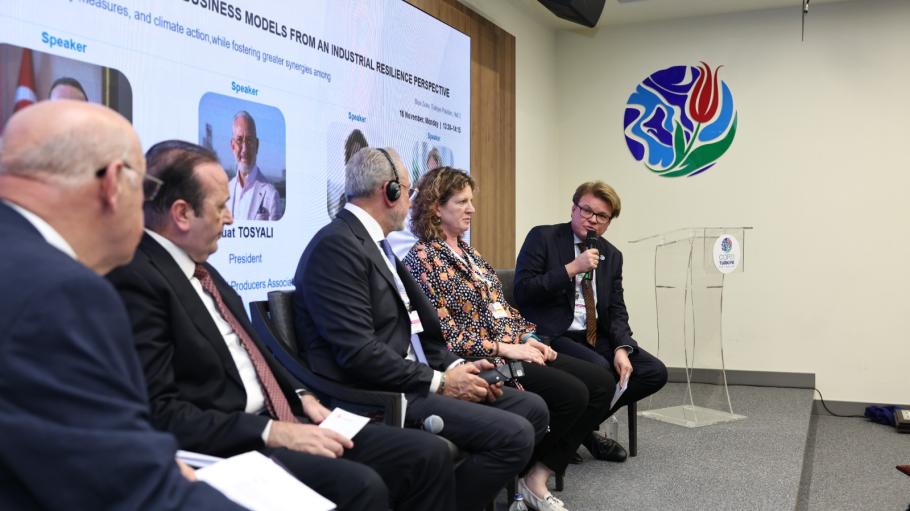
Brussels, 16 November 2026 – EUROFER calls for stronger global climate action, competitive clean electricity and markets for low-carbon steel to turn ambition into industrial investment
Climate targets alone will not deliver green industrialisation without competitive energy, fair carbon costs and demand for low-carbon products, the European Steel Association (EUROFER) warned as world leaders gather for COP31 in Antalya, Türkiye.
The UNFCCC’s COP31 has put industrial transformation and electrification at the centre of its agenda. But while the EU remains committed to climate neutrality by 2050, climate ambition and the costs industries pay for their emissions remain highly divergent worldwide. EUROFER called on major economies to narrow these differences and create the conditions for industry to decarbonise without losing competitiveness.
Speaking at the COP31 in Türkiye, Axel Eggert, Director General of EUROFER, said: “Climate targets alone will not deliver industrial decarbonisation. The EU has set its course, but other major economies must urgently step up their climate ambition, cutting emissions and narrowing the gap in carbon costs. Until they do, effective carbon-leakage protection is essential. The steel industry is ready to transform, but it needs clean electricity at internationally competitive prices and strong markets for low-carbon steel. For the EU it means decarbonising its steel production, not replacing it with imports.”
Europe cannot electrify its steel industry without competitive electricity prices
More than 60 low-carbon steel projects are planned or underway across Europe, potentially cutting annual CO2 emissions by around 80 million tonnes by 2030 if investments materialise. The transformation could require 165 TWh of fossil-free electricity annually, including power to produce 2.12 million tonnes of hydrogen. EUROFER therefore welcomes the COP31's focus on electrification but warns that European energy-intensive industries still face electricity prices two to three times higher than key international competitors. Competitive clean electricity, grids and infrastructure are essential to make industrial decarbonisation commercially viable.
Governments must narrow the global carbon cost gap or risk shifting emissions abroad
Without greater international alignment on climate ambition and carbon costs, industrial production risks moving to countries with weaker climate rules, rather than reducing global emissions. Until this gap narrows, the EU must maintain effective protection against unfair competition. Its Carbon Border Adjustment Mechanism (CBAM), which aims to ensure imported steel faces comparable carbon costs, must protect European steelmakers and industries using their products, alongside a permanent solution for exports. Existing free carbon allowances must not be phased out before CBAM provides effective protection. EUROFER calls for international carbon markets to, ‘Deliver genuine, verifiable emissions reductions without undermining fair competition’.
COP31 must create markets for low-carbon steel
New technologies and clean energy are not enough: steelmakers also need customers willing to buy low-carbon steel. COP31 must help create global and regional demand through public procurement, credible product standards and incentives for cleaner materials. In the EU, the Industrial Accelerator Act must ensure that public support for low-carbon steel also strengthens European production, with steel originally melted and poured in the EU recognised as European-made. Mr. Eggert added, ‘The objective is clear: turn climate ambition into lower emissions, industrial investment and quality jobs, not industrial relocation.’’
Contact
David French, Spokesperson and Head of Communications, +32 2 738 79 35, (d.french@eurofer.eu)
About the European Steel Association (EUROFER)
EUROFER AISBL is located in Brussels and was founded in 1976. It represents the entirety of steel production in the European Union. EUROFER members are steel companies and national steel federations throughout the EU. The major steel companies and national steel federation of Turkey, Ukraine and the United Kingdom are associate members.
The European Steel Association is recorded in the EU transparency register: 93038071152-83.
About the European steel industry
The European steel industry is a world leader in innovation and environmental sustainability. It has a turnover of around €215 billion and directly employs around 298,000 highly-skilled people, producing on average 146 million tonnes of steel per year. More than 500 steel production sites across 22 EU Member States provide direct and indirect employment to millions more European citizens. Closely integrated with Europe’s manufacturing and construction industries, steel is the backbone for development, growth and employment in Europe.
Steel is the most versatile industrial material in the world. The thousands of different grades and types of steel developed by the industry make the modern world possible. Steel is 100% recyclable and therefore is a fundamental part of the circular economy. As a basic engineering material, steel is also an essential factor in the development and deployment of innovative, CO2-mitigating technologies, improving resource efficiency and fostering sustainable development in Europe.
Brussels, 19 November 2026 – Today, the Industry, Research and Energy (ITRE) Committee failed to adopt its opinion on the review of the EU Emissions Trading System (ETS). Europe’s energy-intensive industries (EIIs) express deep disappointment for the missed opportunity to address challenges affecting industrial investments, competitiveness, and jobs in Europe.
Brussels, 17 November 2026 – The European Steel Association (EUROFER) welcomes the European Commission’s decision to impose definitive anti-dumping duties on cold-rolled flat steel imports from India, Japan, Taiwan, Türkiye and Vietnam. The decision follows a complaint by EUROFER in 2025 and marks an important step towards restoring fair competition for European steel producers.
Steel in Action 2026
The European Steel Association (EUROFER)
172 Avenue de Cortenbergh
1000 Brussels
Belgium
Email: mail@eurofer.eu
Phone: +32 (0) 2 738 79 20