Press releases » New report Europe’s steel market outlook
New report: European steel production hits historic low as imports gain record share of EU market
Downloads and links
Recent updates
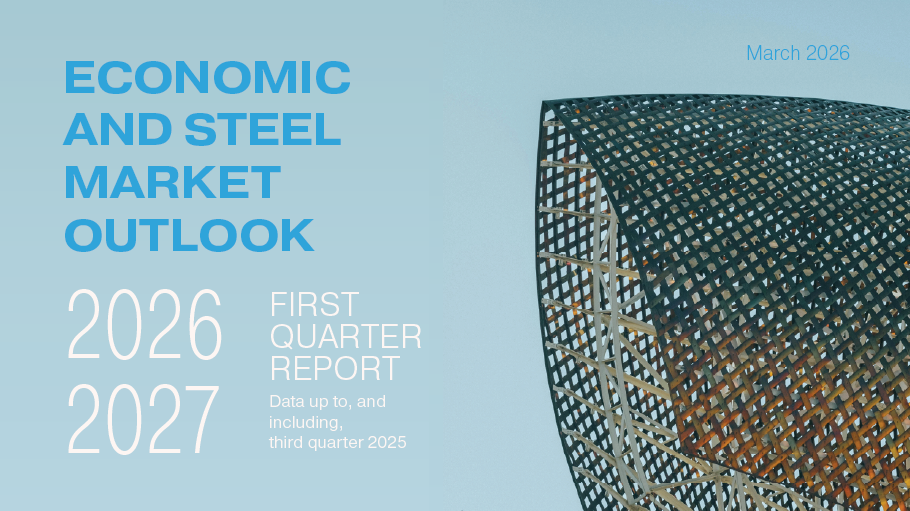
Brussels, 16 March 2026 According to the latest economic report from the European Steel Association (EUROFER), Europe’s steel market is estimated to have shown signs of growth. However, it also highlights how the sector’s outlook is clouded by imports having gained a record share of the EU market, falling European production, volatile energy prices and rising trade tensions.
EU crude steel output falling to a historic low
The report highlights that persistently weak demand has forced the European steel industry to reduce production and restructure capacity, with EU crude steel output falling to a historic low of around 125.8 million tonnes in 2025, compared with 130 million tonnes in 2024.
EU apparent steel consumption - steel demand - is estimated to grow by +2.4% in 2025 and by 1.3% in 2026. However, the increase largely reflects a comparison with exceptionally low demand in previous years, rather than a demand-driven recovery. Even with the projected rebound, European steel consumption will remain well below pre-pandemic levels, by around 11 million tonnes in 2026 and 9 million tonnes in 2027.
Steel imports to the EU see record highs
Import pressure on the EU market also continues to intensify. Steel imports, including semis, rose by +14% in 2025, with finished product imports increasing by +9%, pushing the share of imports in EU steel consumption to a record 29% in the third quarter of 2025.
As a result, the EU’s steel trade balance deteriorated significantly, with the trade deficit widening to around 2 million tonnes per month, including 1.2 million tonnes of finished products.
Axel Eggert, Director-General of EUROFER, said: “Europe’s steel production is shrinking while imports as a share of the EU market are rising. EU policymakers must therefore agree the new steel trade measure quickly without it being weakened otherwise Europe risks losing more industrial capacity. The Iran crisis also shows how exposed European industry remains to global energy shocks. If the EU wants to keep steel production and green investment here, it must deliver both effective trade defence and affordable electricity.’’
War in Iran causes volatile energy prices
Energy markets remain another source of uncertainty. Following the outbreak of the war in Iran, volatility has increased and the benchmark TTF gas price exceeded €50/MWh in March 2026, adding further pressure on industrial competitiveness and investment conditions across Europe’s manufacturing value chains.
Steel-using energy sectors see slight improvements
Industrial activity in steel-using sectors has shown tentative signs of improvement. The Steel Weighted Industrial Production (SWIP) index increased by +1.8% in the third quarter of 2025, after six consecutive quarters of decline. However, the broader outlook remains subdued. SWIP is expected to decline slightly in 2025 (-0.3%) after a sharp contraction in 2024 (-3.6%), before recovering moderately in 2026 (+1.9%) and 2027 (+2.2%). While construction output is beginning to recover, sectors such as automotive and mechanical engineering remain under pressure from weak global demand and trade uncertainty.
Note to editors
The analysis is based on the EUROFER Economic and Steel Market Outlook (Q1 2026) report, which reviews EU market developments up to the third quarter of 2025 and provides an outlook for 2026-2027.
Contact
David French, Spokesperson and Head of Communications, +32 2 738 79 35, (d.french@eurofer.eu)
About the European Steel Association (EUROFER)
EUROFER AISBL is located in Brussels and was founded in 1976. It represents the entirety of steel production in the European Union. EUROFER members are steel companies and national steel federations throughout the EU. The major steel companies and national steel federation of Turkey, Ukraine and the United Kingdom are associate members.
The European Steel Association is recorded in the EU transparency register: 93038071152-83.
About the European steel industry
The European steel industry is a world leader in innovation and environmental sustainability. It has a turnover of around €215 billion and directly employs around 298,000 highly-skilled people, producing on average 146 million tonnes of steel per year. More than 500 steel production sites across 22 EU Member States provide direct and indirect employment to millions more European citizens. Closely integrated with Europe’s manufacturing and construction industries, steel is the backbone for development, growth and employment in Europe.
Steel is the most versatile industrial material in the world. The thousands of different grades and types of steel developed by the industry make the modern world possible. Steel is 100% recyclable and therefore is a fundamental part of the circular economy. As a basic engineering material, steel is also an essential factor in the development and deployment of innovative, CO2-mitigating technologies, improving resource efficiency and fostering sustainable development in Europe.
Steel in Action 2026
Brussels 17 July 2026 - Statement by EUROFER Director General Axel Eggert on the European Commission's proposal to revise the EU Emissions Trading System (ETS):
Brussels, 16 July 2026 - Ahead of the European Commission's review of the EU Emissions Trading System (ETS), the European Steel Association (EUROFER) reaffirmed its support for the EU's climate neutrality objective by 2050, while warning that the ETS can only succeed if it is adapted to market realities and accompanied by the enabling conditions needed for industrial decarbonisation.
The European Steel Association (EUROFER)
172 Avenue de Cortenbergh
1000 Brussels
Belgium
Email: mail@eurofer.eu
Phone: +32 (0) 2 738 79 20