Publications » Position papers » Joint industry messages on E-PRTR Regulation revision
Joint industry messages on E-PRTR Regulation revision
Downloads and links
Recent updates
The E-PRTR Regulation aims to provide the public with accessible information on pollutant releases and transfers and increase public participation in environmental decision-making. The E-PRTR gathers and compiles information about the state of pollutant releases and transfers of large industrial sites across Europe and, as such, it is a very useful tool for the public to follow the environmental impact of these sites over time.
The natural scope of the E-PRTR Regulation should therefore remain the ‘facility’ level and the quality, clarity and comparability of the data should prevail over the quantity of the data.
With this in mind, our associations share the following key messages on the Targeted Stakeholder Survey (TSS) on the E-PRTR Regulation revision:

Download this publication or visit associated links
Brussels, 1 October 2026 - The European Steel Association (EUROFER) has elected Geert Van Poelvoorde, Chairman of the Board of ArcelorMittal Europe Steel, as its new President. Taking office today, Mr Van Poelvoorde said stronger home markets across the steel value chain, secure access to export markets and a strong industrial base will be essential to delivering on the European Union’s ambitions for global competitiveness and strategic autonomy.
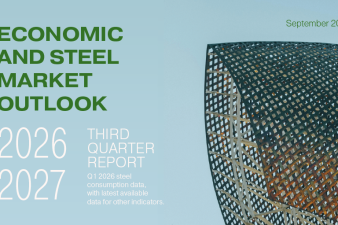
Brussels, 1 October 2026 - Europe’s steel market remains under significant pressure, with exports falling sharply, production at historic lows and demand expected to remain almost flat in 2026, according to the European Steel Association’s (EUROFER) latest Economic and Steel Market Outlook 2026-2027. EU steel exports to third countries fell by 20% in the first half of 2026, with declines across all major export destinations covered by the report. At the same time, crude steel production continued to falter, after reaching a historic low of 125.8 million tonnes in 2025, while apparent steel consumption is forecast to grow by just 0.1% in 2026, before increasing by 2.3% in 2027.
Ship recycling
The European Steel Association (EUROFER)
172 Avenue de Cortenbergh
1000 Brussels
Belgium
Email: mail@eurofer.eu
Phone: +32 (0) 2 738 79 20