Publications » Position papers » Competition Policy & the Green Deal – Joint Submission of the Alliance for Energy-Intensive Industries
Competition Policy & the Green Deal – Joint Submission of the Alliance for Energy-Intensive Industries
Downloads and links
Recent updates
The Alliance of Energy-Intensive Industries, welcomes that the European Commission has decided to launch the debate on how competition policy can support the European Green Deal. The EU’s competition law rules will have an essential role to play in ensuring that the twin objectives of 1) reaching climate neutrality by mid-century and 2) maintaining a strong industrial base in Europe can be achieved.
In a detailed reported published last year ‘The Industrial Transformation Masterplan’ the framework conditions needed for Energy intensives Industries (EIIs) to transition to climate neutrality were identified. Throughout the report, it was evident that more flexible competition law rules are essential in ensuring these framework conditions can be provided.
Looking ahead, to ensure that EU Competition Law Rules are better aligned with the objectives of the Green New Deal, we recommend the following policies, as highlighted in the attached document.

Download this publication or visit associated links
”
The European Steel Association (EUROFER) welcomes the European Commission’s adoption of provisional safeguard measures on imports of Grain-Oriented Electrical Steel (GOES).
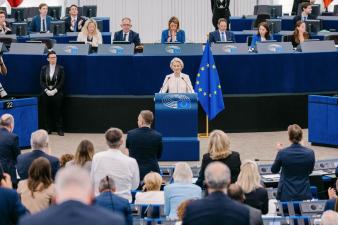
Brussels, 16 September 2026 - Europe’s steel industry has welcomed European Commission President Ursula von der Leyen’s focus on competitiveness, affordable energy and a level playing field, saying these conditions were vital to keep industrial investment and production in Europe.
The European Steel Association (EUROFER)
172 Avenue de Cortenbergh
1000 Brussels
Belgium
Email: mail@eurofer.eu
Phone: +32 (0) 2 738 79 20