Publications » Position papers » Joint industry statement on Industrial Emissions Directive and decarbonisation policy options
Joint industry statement on Industrial Emissions Directive and decarbonisation policy options
Downloads and links
Recent updates
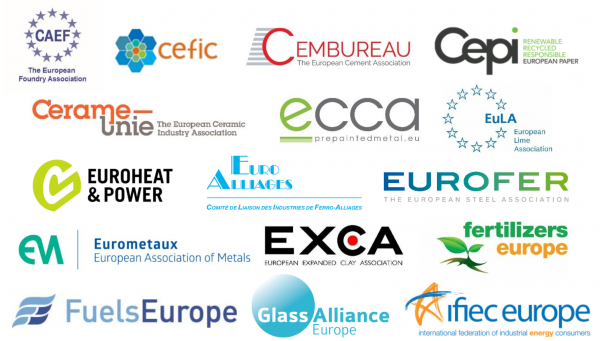
Our associations represent industrial sectors regulated under the Industrial Emissions Directive (IED) and support the Commission’s Green Deal objective to review EU measures to address pollution from large industrial installations, look at the sectoral scope of the legislation and how to make it fully consistent with climate policies.
The disruptive breakthrough technologies necessary to significantly contribute to achieving the climate-neutrality objective will require time to be developed, up scaled and commercialised. On one hand, various GHG abatement options are not available to the same extent across sectors and regions, on the other they are not directly under the control of the operators of IED installations, who to large extent remain dependent on other sectors, notably the energy one.
Mindful of the above considerations, the undersigned sectors have analysed the various policy options considered in context of the TSS and came to the following conclusions:
We support full coherency between policy measures addressing various environmental issues, in particular with regards to the IED, that is the backbone of the environmental legislation applicable to our industrial installations. In the spirit of better regulation principles, amongst others, we reject the option to regulate GHG emissions under an IED permitting regime where those GHG are already regulated under the ETS.
We support:
We conditionally support:
We do not support:
We have strong reservation regarding the option consisting in establishing a long-term permit review obligation (e.g. by 2035) focusing on the capacity of the concerned installations to operate in accordance with EU’s carbon neutrality objective.
A detailed analysis supporting those conclusions is provided in the paper.
Download this publication or visit associated links
Brussels, 1 October 2026 - The European Steel Association (EUROFER) has elected Geert Van Poelvoorde, Chairman of the Board of ArcelorMittal Europe Steel, as its new President. Taking office today, Mr Van Poelvoorde said stronger home markets across the steel value chain, secure access to export markets and a strong industrial base will be essential to delivering on the European Union’s ambitions for global competitiveness and strategic autonomy.
Brussels, 1 October 2026 - Europe’s steel market remains under significant pressure, with exports falling sharply, production at historic lows and demand expected to remain almost flat in 2026, according to the European Steel Association’s (EUROFER) latest Economic and Steel Market Outlook 2026-2027. EU steel exports to third countries fell by 20% in the first half of 2026, with declines across all major export destinations covered by the report. At the same time, crude steel production continued to falter, after reaching a historic low of 125.8 million tonnes in 2025, while apparent steel consumption is forecast to grow by just 0.1% in 2026, before increasing by 2.3% in 2027.
Ship recycling
The European Steel Association (EUROFER)
172 Avenue de Cortenbergh
1000 Brussels
Belgium
Email: mail@eurofer.eu
Phone: +32 (0) 2 738 79 20